![Level Up Your Tabletop Exercises [Webinar Recap]](https://tandem.app/hubfs/Imported_Blog_Media/level-up-your-tabletop-exercises-webinar-recap-by-tandem_1108.png)


Tabletop exercises are a powerful tool for strengthening preparedness and resilience. When done well, they help validate plans, surface gaps, improve coordination, and prepare teams for real-world disruption, far beyond simply meeting a requirement.
In our recent webinar, Level Up Your Tabletop Exercises, GRC Content Manager Alyssa Pugh walked through practical, experience-based guidance for making tabletops more effective and more valuable. The session covered what tabletops are, why they matter, and five concrete ways to improve how they are planned and executed. The webinar concluded with a live mini tabletop exercise to demonstrate these principles in action.
Below is a full recap of the session.
What Is a Tabletop Exercise?
A tabletop exercise is a structured discussion where participants walk through their roles and responses during a simulated adverse event. While often associated with business continuity planning, the same concept applies to incident response, disaster recovery, and cybersecurity preparedness more broadly.
Multiple cybersecurity and resilience frameworks encourage tabletop exercises as part of an overall testing and validation strategy. The goal is not to prove plans are perfect. The goal is to discover gaps and validate assumptions.
Most tabletop exercises follow a familiar lifecycle:
- Decide to conduct an exercise
- Plan logistics and select a scenario
- Invite participants
- Facilitate the discussion
- Document lessons learned and follow-up actions
If not planned well, these sessions can become unfocused, overly complex, or disengaging. Let's talk about how to avoid those outcomes.
Five Tips to Level Up Your Tabletop Exercises
1. Design a Compelling Scenario
Effective tabletop exercises start with a well-designed scenario. Strong scenarios share three core elements:
A threat
The threat anchors the scenario in real organizational risk. Examples include phishing, ransomware, social engineering, fire, or system outages.
A current event
Current events make scenarios realistic and credible. Using real-world trends or seasonal timing helps participants engage with the scenario as something that could actually happen.
A specific business process
Tying the scenario to a concrete process makes it relatable. Rather than discussing an abstract incident, participants consider how disruption affects work they understand.
For example, a scenario involving a deepfake impersonation attempt tied to payment processing combines a real threat, a current trend, and a high-impact business process. Complexity is not required. Many tabletop exercises are most effective when they test foundational policies, procedures, and training rather than extreme edge cases.
A common question addressed during the webinar was whether business continuity and incident response tabletops can be combined. Sometimes they can. However, even when one scenario touches both areas, auditors and examiners may still expect separate documentation and lessons learned for each plan.
2. Gather the Right Team
Tabletop exercises are most effective when the right people are in the room.
Participants should include individuals who:
- Have defined roles in the plan being exercised
- Own or support impacted processes
- Can contribute meaningful insight or decision-making
This often includes IT, information security, risk management, and operations. Depending on the scenario, it may also include HR, marketing, legal, customer service, or lending staff.
External participants can also add value:
- Board members
- Third-party service providers
- Managed service providers
- Insurance breach coaches
- Consultants
- Law enforcement or emergency responders, when appropriate
The goal is not to invite everyone. Research consistently shows that the most productive tabletop exercises include five to eight participants. Fewer may miss critical perspectives. More increases the risk of disengagement.
3. Schedule Strategically
Timing affects participation and outcomes.
Most tabletop exercises are most effective when scheduled for one to two hours. Shorter sessions often lack depth. Longer sessions reduce focus and make future exercises harder to schedule.
Consider participant calendars when scheduling. Avoid stacking tabletops into already overloaded weeks. A poorly timed exercise can create resistance that has nothing to do with the exercise itself.
As for frequency, many organizations conduct tabletop exercises annually, though frequency may vary based on changes in systems, staffing, or risk exposure. There is no single correct cadence. The important thing is selecting a frequency that is realistic, documented, and approved by leadership.
4. Be a Great Host
Facilitation matters.
Small details can significantly impact engagement:
- Provide basic materials like notebooks and pens
- Offer refreshments when appropriate
- Create a welcoming environment
Language also matters. Referring to a tabletop as a "discussion" or "exercise" is more effective than calling it a test. Tests create anxiety and disengagement. Discussions invite participation.
Introducing plot twists can further improve engagement. Scenario modifiers keep participants thinking and prevent the exercise from becoming a rote walkthrough. Examples include:
- Changing the timing of the event
- Impacting a different location or system
- Removing a key employee
- Adding regulatory, legal, or customer pressure
These twists introduce controlled complexity without overwhelming the group.
5. Expect the Unexpected
Tabletop exercises are designed to help you identify gaps. Imperfect outcomes are not failures; they are the point of the exercise.
Participants should expect:
- Errors
- Missing procedures
- Unclear responsibilities
- Escalation challenges
Every issue discovered should result in documented lessons learned and assigned action items. If an exercise produces no lessons learned, it likely did not test the plan deeply enough.
Studying failure in a controlled environment allows organizations to improve plans before real incidents occur.
Putting It Into Practice: A Mini Tabletop Exercise
The webinar concluded with a live tabletop exercise facilitated by Alyssa Pugh and joined by consultants from Boost Consulting: Missy Oliver, Troy Sell, and Joseph Ellis.
The Scenario
An employee is out for Thanksgiving (current event), and someone impersonates them to request a direct deposit change (threat) from accounts payable (business process).
Our consultants emphasized that scenarios like this are effective precisely because they target everyday processes. Most incidents do not begin with advanced attacks. They succeed by exploiting routine workflows and unclear procedures.
Insights From the Discussion
Define first notification clearly. When a suspicious email is identified, there should be no debate about who is notified first, whether that is IT leadership, information security, or another role. Ambiguity slows response when time matters most.
Never respond directly to suspicious messages. Employees should follow documented callback or verification procedures using known contact information. Replying to the original message creates additional risk and often accelerates compromise.
Predefine escalation procedures. Decisions like disabling email access or escalating to leadership should not be made in the moment. Boost Consultants stressed these thresholds should be documented, approved by senior management, and exercised in advance so teams are not improvising during an active incident.
Plan for internal coordination, not just technical response. When the scenario introduced the possibility that a single employee had already made multiple fraudulent changes, the discussion quickly expanded beyond IT. Effective response requires coordination with HR, insurance providers, legal counsel, and external partners, all following predefined procedures.
Throughout the exercise, Boost Consultants reinforced a consistent theme: a successful tabletop is not one where everything goes smoothly. It is one that exposes unclear roles, missing documentation, and unrealistic assumptions. Every gap identified is an opportunity to strengthen the plan before a real incident forces the issue.
Webinar Q&A
Q: Is it possible to conduct BCP and incident response tabletops at the same time?
A: Sometimes. A single scenario can address both continuity and response questions, but auditors and examiners may still expect separate documentation and lessons learned for each plan.
Q: How do you handle a required bank-wide exercise if optimal tabletop size is five to eight people?
A: Bank-wide tests like employee alerts can involve everyone. Tabletop discussions focused on plan adequacy and decision-making are better suited for smaller groups.
Q: Can disaster recovery drills be combined with tabletop exercises?
A: Yes. Disaster recovery testing is often part of a broader BCP exercise. Just ensure lessons learned are documented clearly.
Q: Should the tabletop host participate or act only as a facilitator?
A: Either approach can work. Define roles in advance. The host may facilitate, introduce scenario changes, or play limited roles as needed.
Q: Why are some scenarios available only in BCP or only in incident management tools?
A: Scenarios are designed to test specific plans. Some align better with continuity objectives, others with incident response. Organizations can still adapt scenarios across plans if appropriate.
Tabletop exercises are not just a checkbox. When designed thoughtfully, facilitated well, and followed by action, they are one of the most effective tools organizations have to improve resilience and response readiness.
How Tandem Can Help
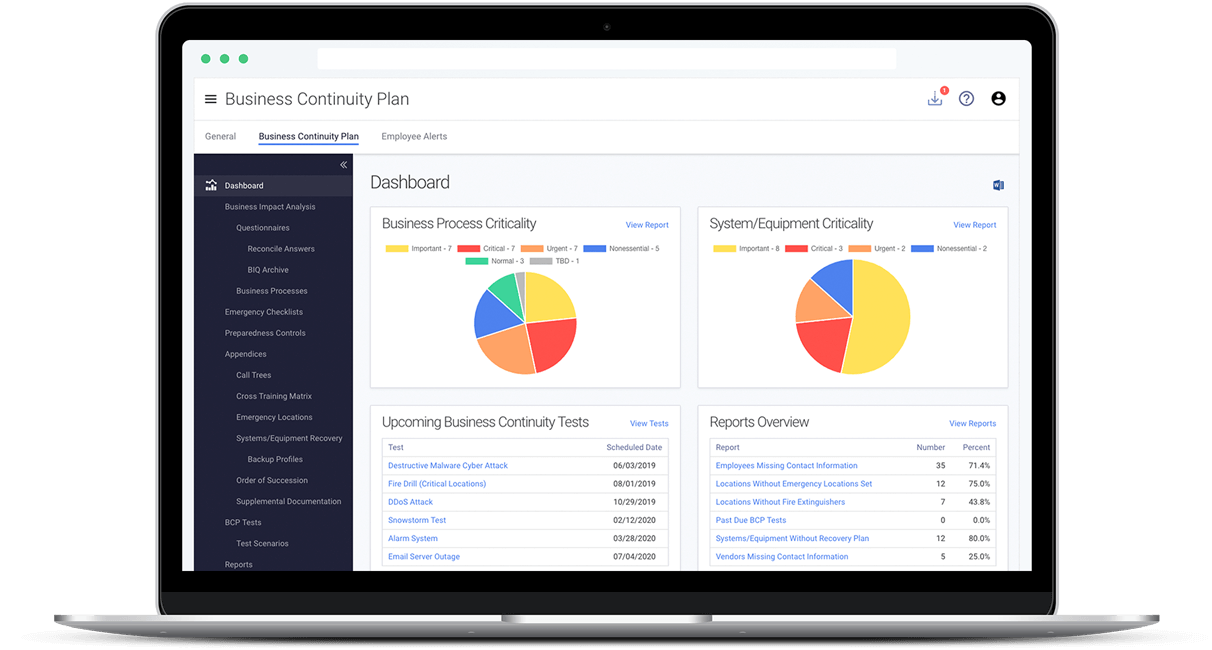
If you are looking for help with planning and documenting your tabletop exercises, Tandem's Business Continuity Plan and Incident Management products feature a variety of scenarios and tools designed to make tabletops easy.
These scenarios, which are updated regularly, include discussion questions, lessons learned, and you can even send reminder notifications from the software to responsible parties ahead of time.
After you document your exercise, you can easily share this information with your board, management, and examiners with customizable document downloads straight from the software.
Watch a demo to learn more about how Tandem can help you level up your tabletop exercises.